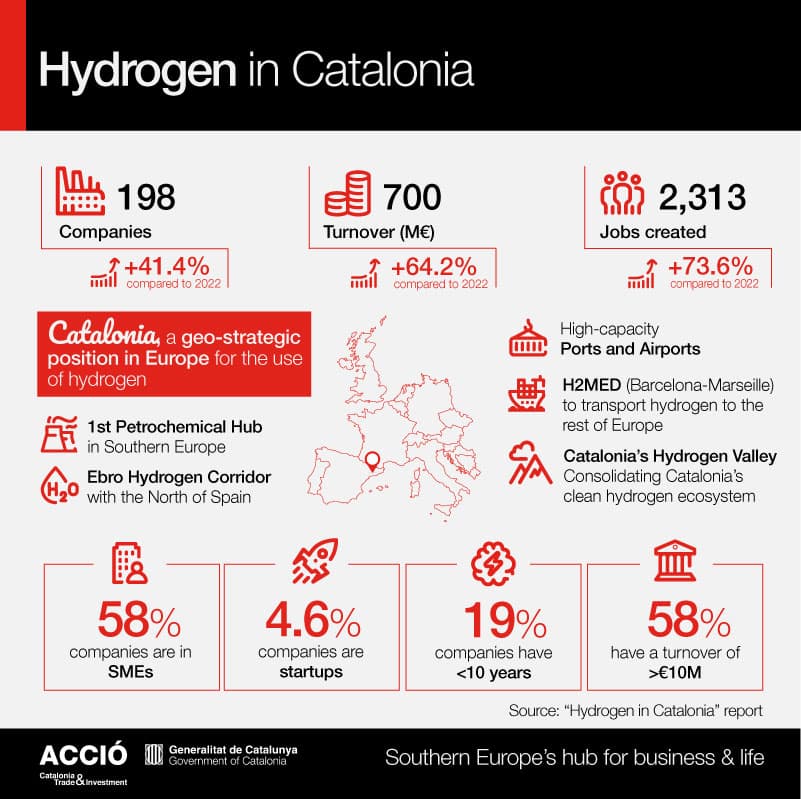
Hydrogen is rapidly emerging globally as a cornerstone of the energy transition, with its potential for decarbonizing industries and achieving climate goals. By 2050, the clean hydrogen market is expected to exceed $1.4 trillion annually, with cumulative investments surpassing $9 trillion to meet emissions targets. This rapidly growing sector is also projected to create 2 million jobs globally each year between 2030 and 2050.
Search our database to find Catalan companies involved in hydrogen development.
Recognizing this immense opportunity, Catalonia has positioned itself as southern Europe’s benchmark hydrogen valley, leveraging its strategic location, robust infrastructure, and innovative ecosystem to lead in this industry.
All eyes on hydrogen
Hydrogen holds unique properties that make it a cornerstone of energy innovation. It is the lightest chemical element and, under normal conditions, takes the shape of a tasteless, colorless, and odorless gas. It possesses the highest energy content by weight of any conventional fuel—three times that of diesel, natural gas, or bioethanol.
Typically found in a gaseous state, hydrogen only liquefies at temperatures below -253°C, a process that increases its density by a factor of 800. Due to its low density and excellent flammability, hydrogen is stored under pressure and requires innovative solutions to manage its energy potential safely and effectively.
Catalonia, an ideal location
Catalonia is well-positioned to become a leading hydrogen hub in southern Europe, boasting a robust ecosystem with 198 companies, 14 research centers, 21 clusters, and numerous public institutions, all driving hydrogen innovation. A significant share of these companies—nearly 58%—are SMEs, and 19% are less than a decade old, showcasing a dynamic and forward-thinking sector.
In 2023, Catalonia’s hydrogen industry generated €700 million in turnover and created over 2,300 jobs. Looking ahead, the region aims to achieve ambitious goals by 2030, including €8.9 billion in investments, 4 GW of electrolyzer capacity, 25% of industrial energy consumption powered by hydrogen, and 100–150 public hydrogen refueling stations.
Catalonia's ideal geo-strategic location and extensive network of infrastructures allows for efficient intercontinental connections with Asia and America, as well as quick and easy distribution in southern Europe and North Africa, making it a reference point for supplying hydrogen there, a market containing some 400 million consumers, reachable in less than 48 hours.
Two top Mediterranean ports
Catalonia is also home to two of the Mediterranean’s most important ports, the Port of Barcelona and the Port of Tarragona. Specializing in general cargo and high-value-added goods, the Port of Barcelona is a key hub in the Euro-Mediterranean region, boasting connections to 178 ports worldwide through 88 regular lines. With its exceptional productivity—among the highest in Europe—it leads Spain in terms of goods value and is Catalonia’s most significant transportation and services infrastructure. It also houses a hydrogen plant built to support the 37th America’s Cup held in 2024, underscoring its commitment to innovation and sustainability.
As regards the Port of Tarragona, with world-class infrastructure and innovative designs, it has established itself as a Mediterranean hub for the storage and distribution of energy products. Investments in its Chemical Dock have doubled the port’s dedicated area for storing bulk liquids, including hydrocarbons, chemical products, and energy transition derivatives such as ammonia for hydrogen capture and storage. Currently, the port boasts a storage capacity exceeding 800,000 m3, with plans to expand incrementally to 1.2 million m3 in the coming years.